European flags
Flag of Austria
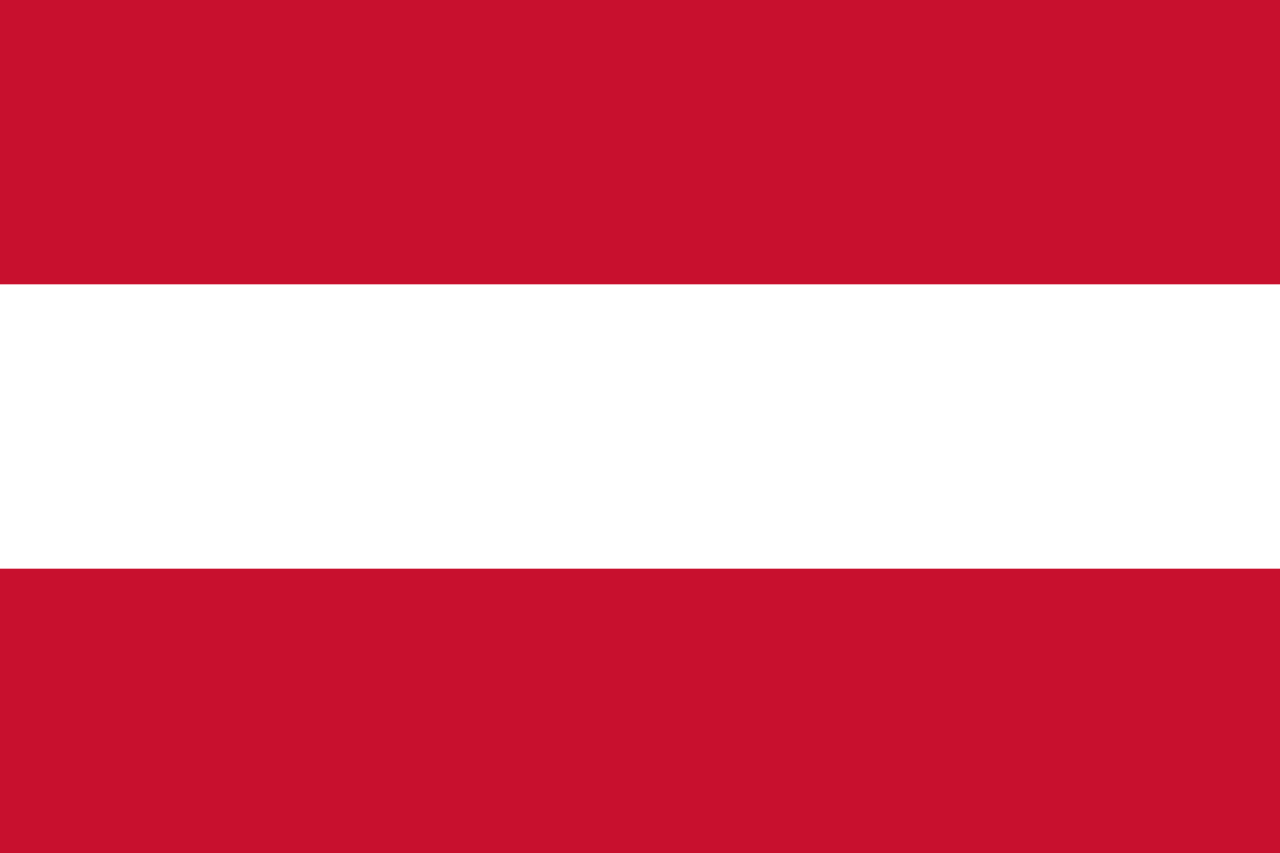
The flag of Austria is the official national symbol of Republic of Austria, whose capital is Vienna. On this page you can view and download a high-quality image of the Austria flag, copy the Austria flag emoji, and learn key facts about this sovereign country in Europe.
Country information
| Independent | Yes |
|---|---|
| Country codes | AT, AUT (ISO 3166-1) |
| Official name | Republic of Austria |
| Capital city | Vienna |
| Continent | Europe |
| Member of | United Nations, European Union |
| Population | 8,840,521 |
| Total area | 83,871 km² |
| Languages | Austro-Bavarian German |
| Currency | Euro (€, EUR) |
| Calling code | +43 |
| Internet TLD | .at |
About the flag of Austria
The Austria flag represents the identity, history and values of its people — the Austrian people. It is flown on government buildings, at international events and during national celebrations, and it appears at the United Nations, sporting tournaments and diplomatic missions around the world.
Austria is a landlocked sovereign country located in Central Europe, covering an area of 83,871 km² with a population of roughly 8,840,521. The main language is Austro-Bavarian German.
Design, meaning and history of the Austria flag
Design
The flag of Austria consists of three equal horizontal bands of red, white, and red. It is a simple triband devoid of emblems or charges in its civil version, using an aspect ratio of 2:3.
Meaning of the colours and symbols
The red and white stripes are historically derived from the coat of arms of the medieval Babenberg dynasty. Popular legend links the design to Duke Leopold V during the Siege of Acre in 1191, whose white tunic was completely saturated in blood except for the section covered by his belt. In modern heraldic interpretation, the colors are accepted as historical markers of the Austrian realm rather than having an official ideological meaning.
History
The red-white-red pattern traces back to Duke Frederick II of the Babenberg dynasty, who incorporated the design onto his seal in 1230. In 1786, Holy Roman Emperor Joseph II introduced the colors as Austria's naval ensign. The triband was formally declared the national flag of the First Republic of Austria in 1918 following the collapse of the Austro-Hungarian Empire, was suspended during the German annexation (1938–1945), and was officially reinstated on May 1, 1945.
- Adopted: May 1, 1945
- Proportions: 2:3
Interesting facts
- Austria's red-white-red triband is widely considered one of the oldest national flag designs in the world, with documented use dating to 1230.
- The state flag of Austria includes the federal coat of arms—a black eagle with broken chains—centered across the stripes.
- During the Austro-Hungarian period, this triband was used primarily as a war ensign and naval flag rather than a universal national flag.
Map of Austria
Flags of countries bordering Austria



More European flags





Austria flag — frequently asked questions
How old is the Austrian flag design?
The red-white-red color scheme was adopted on the ducal seal of Frederick II in 1230, making it over 790 years old.
What is the legend behind the colors of the Austrian flag?
Legend claims that Duke Leopold V's tunic was drenched in blood during the 1191 Siege of Acre, leaving only a white strip where his belt had been.
Does the Austrian flag include an eagle?
The civil flag used by the public is a plain triband; only the official state flag includes the federal coat of arms with the eagle.
What is the capital of Austria?
The capital city of Austria is Vienna.
What is the Austria flag emoji?
The Austria flag emoji is 🇦🇹. Visit the emoji page to copy and paste it.
What are the country codes of Austria?
The ISO 3166-1 codes for Austria are AT and AUT.