European flags
Flag of Denmark
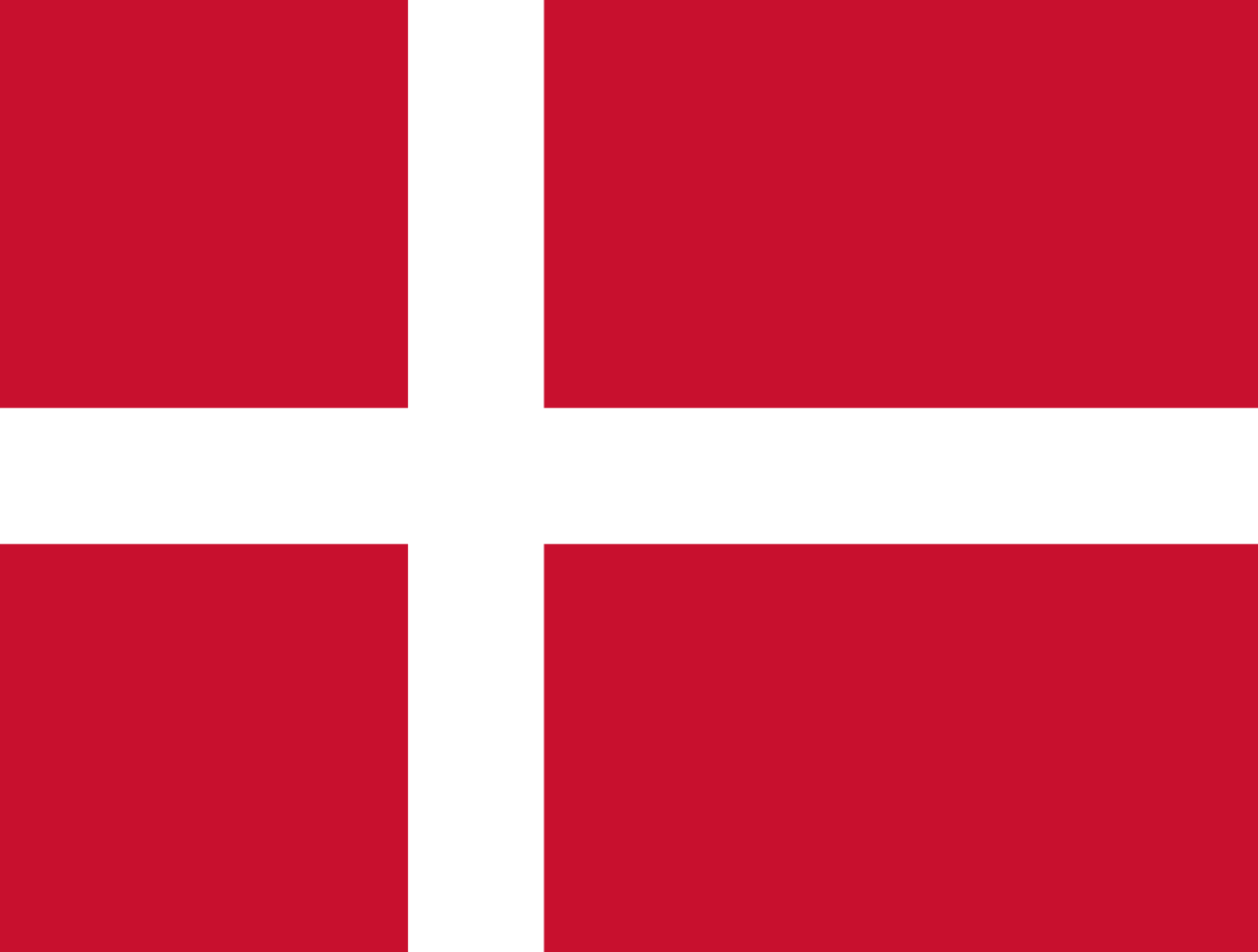
The flag of Denmark is the official national symbol of Kingdom of Denmark, whose capital is Copenhagen. On this page you can view and download a high-quality image of the Denmark flag, copy the Denmark flag emoji, and learn key facts about this sovereign country in Europe.
Country information
| Independent | Yes |
|---|---|
| Country codes | DK, DNK (ISO 3166-1) |
| Official name | Kingdom of Denmark |
| Capital city | Copenhagen |
| Continent | Europe |
| Member of | United Nations, European Union, North Atlantic Treaty Organization, Nordic Council |
| Population | 5,793,636 |
| Total area | 43,094 km² |
| Languages | Danish |
| Currency | Danish krone (kr, DKK) |
| Calling code | +45 |
| Internet TLD | .dk |
About the flag of Denmark
The Denmark flag represents the identity, history and values of its people — the Danish people. It is flown on government buildings, at international events and during national celebrations, and it appears at the United Nations, sporting tournaments and diplomatic missions around the world.
Denmark is a sovereign country located in Northern Europe, covering an area of 43,094 km² with a population of roughly 5,793,636. The main language is Danish.
Design, meaning and history of the Denmark flag
Design
The flag of Denmark, known as the Dannebrog, features a solid red field charged with an off-center white Scandinavian cross that extends to the edges of the flag. The vertical arm of the cross is shifted toward the hoist side.
Meaning of the colours and symbols
The white cross represents Christianity, while the red field is traditionally associated with royal authority and battlefield valor. Together, the colors and cross have served as a symbol of Danish national identity and monarchy for centuries.
History
According to national legend, the Dannebrog fell from the sky during the Battle of Lindanise (modern-day Tallinn, Estonia) on June 15, 1219. Historical records reliably document its use by Danish kings by the 14th century, particularly appearing in the Gelre Armorial around 1370. It was officially codified for merchant vessels in 1748 and is recognized by Guinness World Records as the oldest continuously used national flag.
- Adopted: May 1, 1893
- Proportions: 28:37
Interesting facts
- The Dannebrog holds the world record for the oldest continuously used national flag.
- It established the Scandinavian cross design later adopted by Sweden, Norway, Finland, and Iceland.
- Danish law prohibits the public flying of foreign national flags without special permission, except for Nordic and EU flags.
Map of Denmark
Flags of countries bordering Denmark

More European flags

Denmark flag — frequently asked questions
What does the name 'Dannebrog' mean?
Dannebrog translates roughly to 'the cloth of the Danes' or 'the Danish cloth' in Old Danish.
What is the legend behind the Danish flag's origin?
Legend states that the flag fell from heaven during the Battle of Lindanise in Estonia on June 15, 1219, rallying King Valdemar II's forces to victory.
Is the civil flag different from the state and naval flag in Denmark?
Yes, while civilians use the rectangular flag, the Danish military and royal authorities fly a swallowtail version known as the Splitflag.
What is the capital of Denmark?
The capital city of Denmark is Copenhagen.
What is the Denmark flag emoji?
The Denmark flag emoji is 🇩🇰. Visit the emoji page to copy and paste it.
What are the country codes of Denmark?
The ISO 3166-1 codes for Denmark are DK and DNK.