European flags
Flag of Portugal
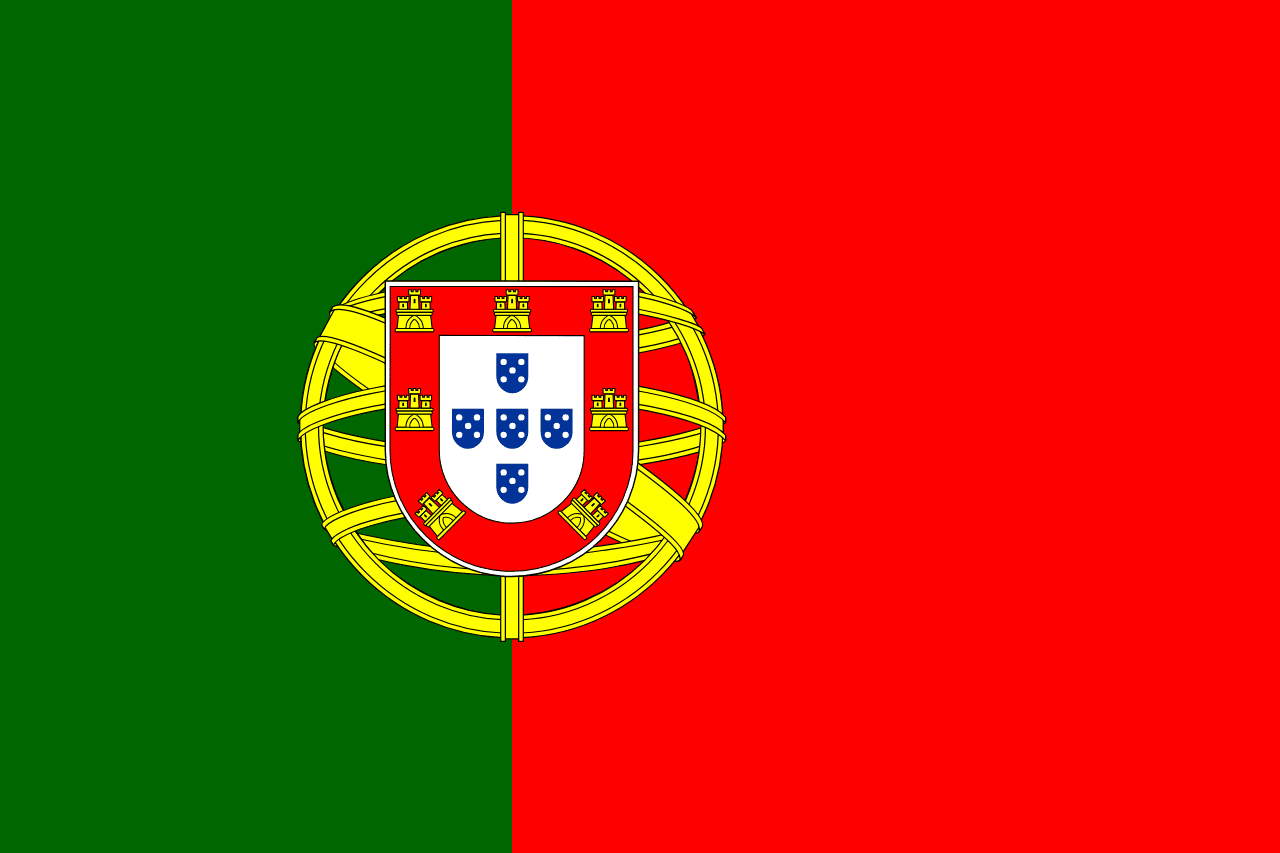
The flag of Portugal is the official national symbol of Portuguese Republic, whose capital is Lisbon. On this page you can view and download a high-quality image of the Portugal flag, copy the Portugal flag emoji, and learn key facts about this sovereign country in Europe.
Country information
| Independent | Yes |
|---|---|
| Country codes | PT, PRT (ISO 3166-1) |
| Official name | Portuguese Republic |
| Capital city | Lisbon |
| Continent | Europe |
| Member of | United Nations, European Union, North Atlantic Treaty Organization |
| Population | 10,283,822 |
| Total area | 92,090 km² |
| Languages | Portuguese |
| Currency | Euro (€, EUR) |
| Calling code | +351 |
| Internet TLD | .pt |
About the flag of Portugal
The Portugal flag represents the identity, history and values of its people — the Portuguese people. It is flown on government buildings, at international events and during national celebrations, and it appears at the United Nations, sporting tournaments and diplomatic missions around the world.
Portugal is a sovereign country located in Southern Europe, covering an area of 92,090 km² with a population of roughly 10,283,822. The main language is Portuguese.
Design, meaning and history of the Portugal flag
Design
The flag is a vertical bicolour divided unequally into green at the hoist and red at the fly, with green occupying two-fifths and red occupying three-fifths of the total width. Centred along the boundary line of the two colours is the lesser coat of arms of Portugal. This emblem consists of an armillary sphere in yellow supporting a white shield charged with five blue escutcheons and bordered in red with seven yellow castles.
Meaning of the colours and symbols
Under the republican government that adopted the flag, green was designated to represent hope for the nation's future, while red symbolized the blood of patriots shed during service to Portugal. The golden armillary sphere recalls the navigational science that drove the Portuguese Age of Discovery. The white shield with five blue quinas commemorates the five Moorish kings defeated by Afonso Henriques, while the seven castles signify the fortified towns recaptured during the Reconquista.
History
For centuries, the royal flags of Portugal were predominantly white and blue, the traditional colours of the monarchy. Following the Republican Revolution of October 5, 1910, a special governmental committee was formed to select new national symbols that broke with monarchical tradition. The current design was created by painter Columbano Bordalo Pinheiro, journalist João Chagas, and writer Abel Botelho, and was officially adopted on June 30, 1911. Despite minor adjustments to manufacturing standards over time, the fundamental design has remained unchanged.
- Adopted: June 30, 1911
- Proportions: 2:3
Interesting facts
- The vertical division is asymmetrical, allocating 40 percent of the width to green and 60 percent to red.
- The armillary sphere was originally introduced to Portuguese royal heraldry by King Manuel I in the late fifteenth century.
- The five blue shields contain five white dots each, historically said to represent the thirty pieces of silver paid to Judas, counting the central shield twice.
Map of Portugal
Flags of countries bordering Portugal
More European flags



Portugal flag — frequently asked questions
What is the yellow circular device behind the central shield?
It is an armillary sphere, an astronomical and navigational instrument used by Portuguese navigators during the Age of Discovery to determine celestial coordinates.
Why were Portugal's historical blue and white flag colours abandoned?
Blue and white were strongly identified with the overthrown constitutional monarchy, prompting the republican regime in 1910 to adopt the red and green colours of the Portuguese Republican Party.
What do the seven gold castles represent?
The castles represent the fortified Moorish strongholds captured by King Afonso III during the final reconquest of the Algarve in the thirteenth century.
What is the capital of Portugal?
The capital city of Portugal is Lisbon.
What is the Portugal flag emoji?
The Portugal flag emoji is 🇵🇹. Visit the emoji page to copy and paste it.
What are the country codes of Portugal?
The ISO 3166-1 codes for Portugal are PT and PRT.