North American flags
Flag of Turks and Caicos Islands
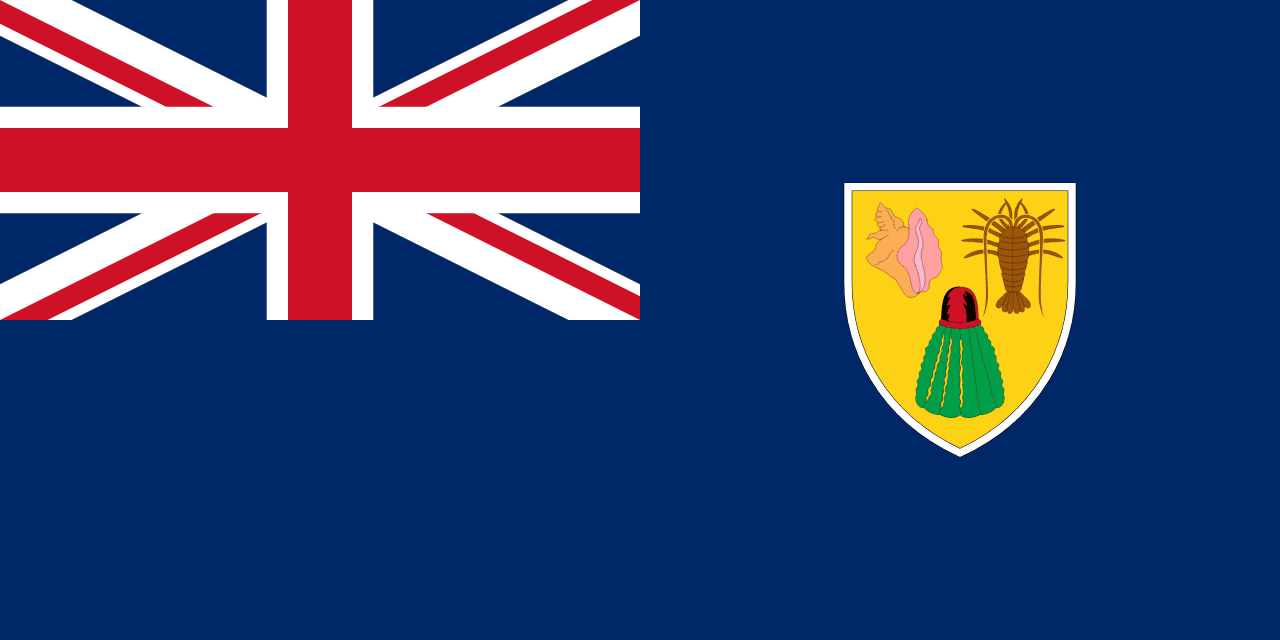
The flag of Turks and Caicos Islands is the official national symbol of Turks and Caicos Islands, whose capital is Cockburn Town. On this page you can view and download a high-quality image of the Turks and Caicos Islands flag, copy the Turks and Caicos Islands flag emoji, and learn key facts about this territory in North America.
Country information
| Independent | No |
|---|---|
| Country codes | TC, TCA (ISO 3166-1) |
| Official name | Turks and Caicos Islands |
| Capital city | Cockburn Town |
| Continent | North America |
| Member of | — |
| Population | 37,665 |
| Total area | 948 km² |
| Languages | English |
| Currency | United States dollar ($, USD) |
| Calling code | +1649 |
| Internet TLD | .tc |
About the flag of Turks and Caicos Islands
The Turks and Caicos Islands flag represents the identity, history and values of its people — the Turks and Caicos Islander people. It is flown on government buildings, at international events and during national celebrations, and it appears at the United Nations, sporting tournaments and diplomatic missions around the world.
Turks and Caicos Islands is a territory located in Caribbean, covering an area of 948 km² with a population of roughly 37,665. The main language is English.
Design, meaning and history of the Turks and Caicos Islands flag
Design
The flag is a British Blue Ensign consisting of a dark blue field with the Union Jack in the canton. The fly is charged with the shield of the territory's coat of arms, which features a golden-yellow field bearing a queen conch shell, a spiny lobster, and a Turks cap cactus.
Meaning of the colours and symbols
The Union Jack denotes the islands' political status as a British Overseas Territory. The yellow shield represents the islands' sunny climate and sandy beaches. The conch shell and Caribbean spiny lobster celebrate the traditional marine industries and local ecology, while the flowering Turks cap cactus honors native flora and the islands' namesake.
History
The coat of arms of the Turks and Caicos Islands was officially granted by Queen Elizabeth II on September 28, 1965. The territorial blue ensign displaying this shield was officially adopted on November 7, 1968, replacing an older circular colonial badge showing a salt-raker at work. In 1999, the size of the badge was enlarged and updated in line with standardized British Ministry of Defence flag specifications.
- Adopted: November 7, 1968
- Proportions: 1:2
Interesting facts
- The islands take their name from the Turks cap cactus depicted on the lower half of the shield.
- Before 1965, the colonial badge depicted an islander collecting sea salt alongside a ship and two salt mounds.
- The badge in the fly was significantly enlarged in 1999 as part of an overhaul of British Overseas Territory ensigns.
Map of Turks and Caicos Islands
More North American flags


Turks and Caicos Islands flag — frequently asked questions
What three items are depicted on the shield of the Turks and Caicos flag?
The golden shield depicts a queen conch shell, a Caribbean spiny lobster, and a flowering Turks cap cactus.
How did the Turks cap cactus give the islands their name?
The cactus develops a reddish cephalium on top that early European sailors thought resembled a Turkish fez hat.
Why was the flag updated in 1999?
The UK Ministry of Defence standardized overseas territory flags in 1999, enlarging the shield and removing the white circular background.
What is the capital of Turks and Caicos Islands?
The capital city of Turks and Caicos Islands is Cockburn Town.
What is the Turks and Caicos Islands flag emoji?
The Turks and Caicos Islands flag emoji is 🇹🇨. Visit the emoji page to copy and paste it.
What are the country codes of Turks and Caicos Islands?
The ISO 3166-1 codes for Turks and Caicos Islands are TC and TCA.