Oceanian flags
Flag of Samoa
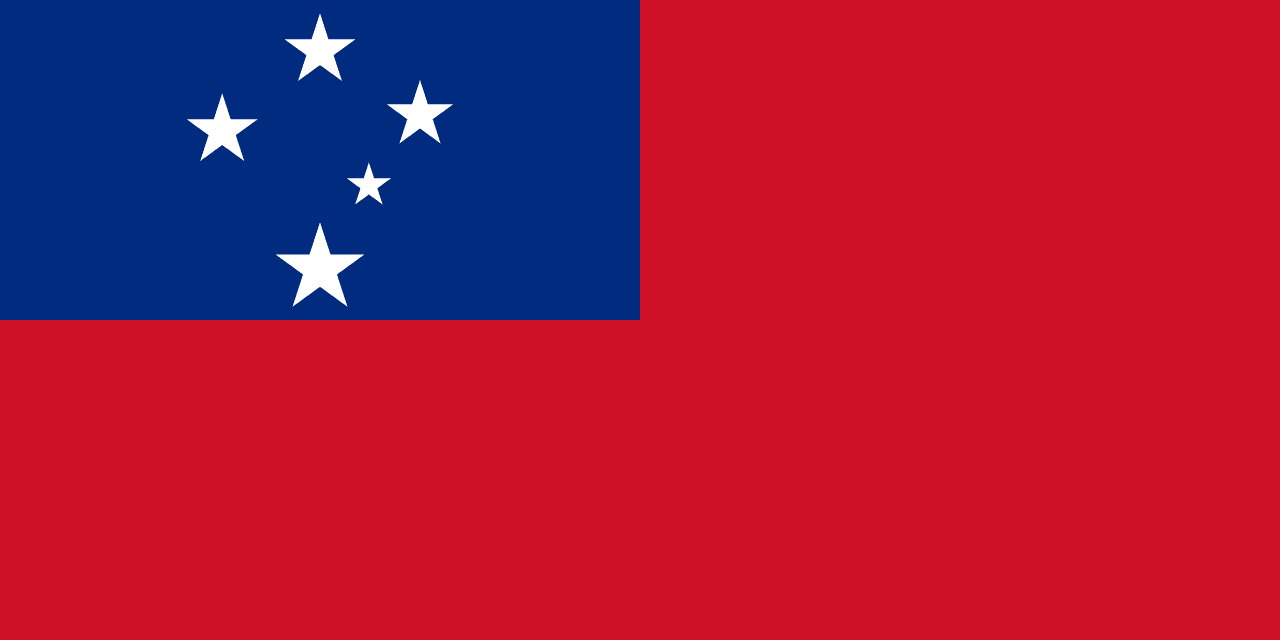
The flag of Samoa is the official national symbol of Independent State of Samoa, whose capital is Apia. On this page you can view and download a high-quality image of the Samoa flag, copy the Samoa flag emoji, and learn key facts about this sovereign country in Oceania.
Country information
| Independent | Yes |
|---|---|
| Country codes | WS, WSM (ISO 3166-1) |
| Official name | Independent State of Samoa |
| Capital city | Apia |
| Continent | Oceania |
| Member of | United Nations, Commonwealth of Nations, Pacific Community |
| Population | 196,130 |
| Total area | 2,842 km² |
| Languages | English, Samoan |
| Currency | Samoan tālā (T, WST) |
| Calling code | +685 |
| Internet TLD | .ws |
About the flag of Samoa
The Samoa flag represents the identity, history and values of its people — the Samoan people. It is flown on government buildings, at international events and during national celebrations, and it appears at the United Nations, sporting tournaments and diplomatic missions around the world.
Samoa is a sovereign country located in Polynesia, covering an area of 2,842 km² with a population of roughly 196,130. The main languages are English, Samoan.
Design, meaning and history of the Samoa flag
Design
The flag of Samoa features a red field with a blue canton in the upper hoist quadrant. Inside the canton are five white, five-pointed stars arranged to depict the Southern Cross constellation. Four of the stars are identical in size, while the fifth star is smaller to reflect its lower visual magnitude.
Meaning of the colours and symbols
The red field represents courage, while the white of the stars symbolizes purity. The blue canton signifies freedom and the surrounding Pacific Ocean. The Southern Cross denotes Samoa's geographical location in the Southern Hemisphere and is also commonly interpreted as a reflection of the nation's Christian heritage.
History
During New Zealand's administration of Western Samoa as a United Nations Trust Territory, a local flag was introduced in June 1948 featuring four stars in the Southern Cross. On February 24, 1949, the design was altered by adding a fifth, smaller star to provide an astronomically accurate representation of the constellation. This five-star flag was formally established by the Samoa Flag and Coat of Arms Act. When the country achieved full independence from New Zealand on January 1, 1962, it retained the 1949 design without modification.
- Adopted: February 24, 1949
- Proportions: 1:2
Interesting facts
- The initial 1948 version of the flag had only four stars, closely echoing the constellation layout on the New Zealand flag.
- The fifth star, Epsilon Crucis, is scaled smaller than the other four to reflect its dimmer appearance in the night sky.
- The flag remained completely unchanged when the nation officially shortened its name from Western Samoa to Samoa in 1997.
Map of Samoa
More Oceanian flags




Samoa flag — frequently asked questions
Why was a fifth star added to the Samoan flag in 1949?
The original 1948 design included only four stars, mimicking New Zealand's version of the Southern Cross. The fifth star was added on February 24, 1949, to depict the constellation more accurately.
Did Samoa change its flag when it changed its name in 1997?
No, the flag remained identical when the country transitioned its official name from the Independent State of Western Samoa to the Independent State of Samoa in July 1997.
How does the flag of Samoa differ from the flag of Taiwan?
Although both share a red field and a blue canton, Samoa displays five white stars forming the Southern Cross, whereas Taiwan displays a white sun with twelve rays.
What is the capital of Samoa?
The capital city of Samoa is Apia.
What is the Samoa flag emoji?
The Samoa flag emoji is 🇼🇸. Visit the emoji page to copy and paste it.
What are the country codes of Samoa?
The ISO 3166-1 codes for Samoa are WS and WSM.