South American flags
Flag of Uruguay
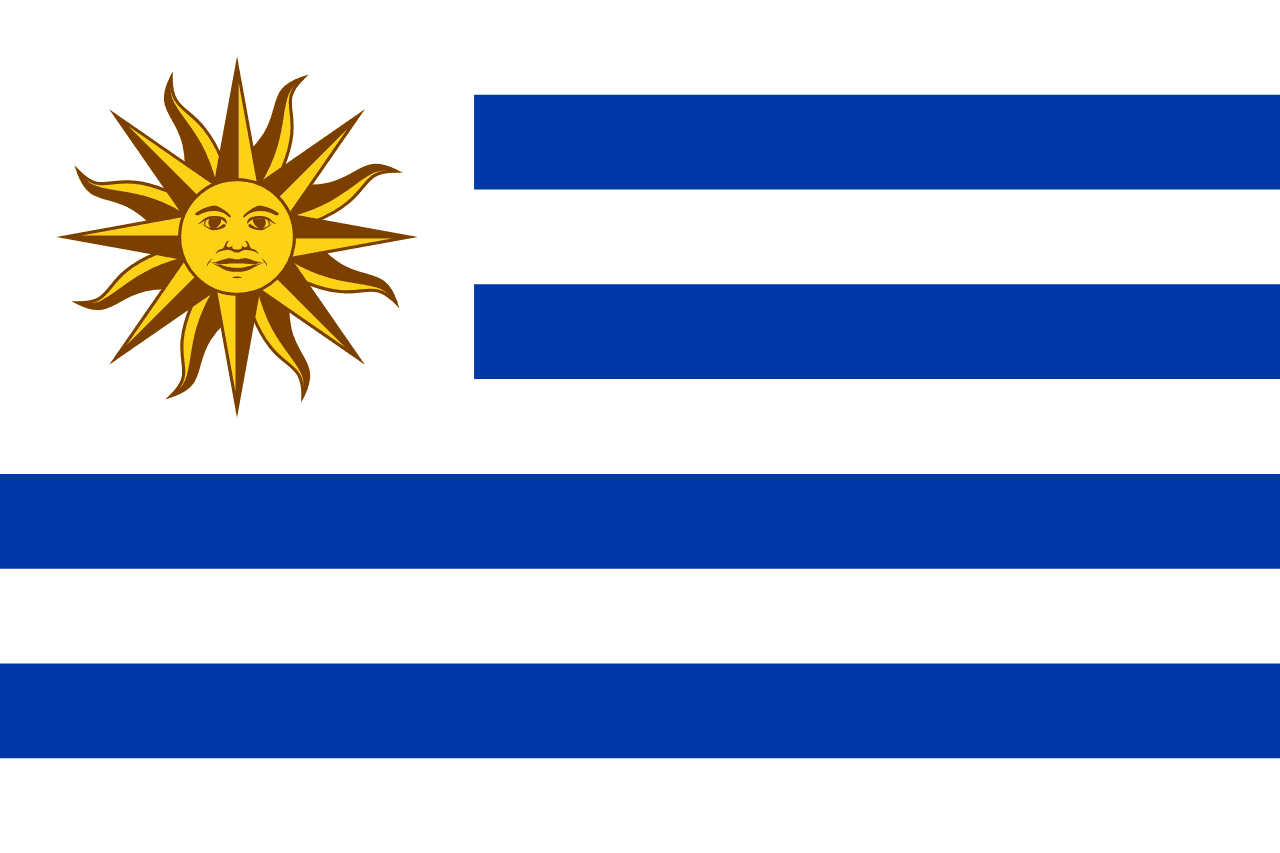
The flag of Uruguay is the official national symbol of Oriental Republic of Uruguay, whose capital is Montevideo. On this page you can view and download a high-quality image of the Uruguay flag, copy the Uruguay flag emoji, and learn key facts about this sovereign country in South America.
Country information
| Independent | Yes |
|---|---|
| Country codes | UY, URY (ISO 3166-1) |
| Official name | Oriental Republic of Uruguay |
| Capital city | Montevideo |
| Continent | South America |
| Member of | United Nations, Organization of American States, Union of South American Nations |
| Population | 3,449,299 |
| Total area | 181,034 km² |
| Languages | Spanish |
| Currency | Uruguayan peso ($, UYU) |
| Calling code | +598 |
| Internet TLD | .uy |
About the flag of Uruguay
The Uruguay flag represents the identity, history and values of its people — the Uruguayan people. It is flown on government buildings, at international events and during national celebrations, and it appears at the United Nations, sporting tournaments and diplomatic missions around the world.
Uruguay is a sovereign country located in South America, covering an area of 181,034 km² with a population of roughly 3,449,299. The main language is Spanish.
Design, meaning and history of the Uruguay flag
Design
The flag consists of nine equal horizontal alternating stripes of white and blue, with five white stripes and four blue stripes. A white canton in the upper hoist spans the height of the top five stripes and contains the golden Sun of May. The sun features a humanized face surrounded by sixteen rays that alternate between straight and wavy.
Meaning of the colours and symbols
The nine horizontal stripes represent the original nine departments into which Uruguay was divided at the time of its independence. The Sun of May (Sol de Mayo) is a symbol of liberation that recalls the May Revolution of 1810 in the Viceroyalty of the Río de la Plata. The sun also honors Inti, the sun god of Incan mythology.
History
Designed by statesman Joaquín Suárez, Uruguay's first national flag was established by law on December 16, 1828, featuring nineteen alternating blue and white stripes. This arrangement proved difficult to distinguish at a distance, prompting a legal revision on July 11, 1830, which reduced the design to nine stripes. The colours and solar emblem directly reflect Uruguay's historical ties with Argentina. In domestic law, Uruguay also officially recognizes two co-official historical banners: the Flag of Artigas and the Flag of the Treinta y Tres.
- Adopted: July 11, 1830
- Proportions: 2:3
Interesting facts
- Uruguay is one of the few nations with three official state flags, though the nine-striped Sun of May flag is the primary national banner.
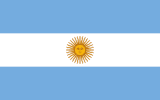
- The Sun of May on Uruguay's flag has sixteen rays, whereas the sun on neighbouring Argentina's flag features thirty-two.
- The original 1828 design contained nineteen stripes, one for each department projected under early administrative plans.
Map of Uruguay
Flags of countries bordering Uruguay
More South American flags

Uruguay flag — frequently asked questions
What does the sun on the Uruguayan flag represent?
It is the Sun of May, symbolizing the 1810 revolution for independence in the Río de la Plata region and referencing the Incan sun god Inti.
Why does the flag of Uruguay have nine stripes?
The nine alternating white and blue stripes represent the nine original departments of Uruguay when the constitution was established.
How does Uruguay's flag differ from Argentina's?
While both share blue and white colours and the Sun of May, Uruguay places its 16-ray sun in a canton alongside nine stripes, whereas Argentina centers a 32-ray sun on three horizontal bands.
What is the capital of Uruguay?
The capital city of Uruguay is Montevideo.
What is the Uruguay flag emoji?
The Uruguay flag emoji is 🇺🇾. Visit the emoji page to copy and paste it.
What are the country codes of Uruguay?
The ISO 3166-1 codes for Uruguay are UY and URY.