Asian flags
Flag of Nepal
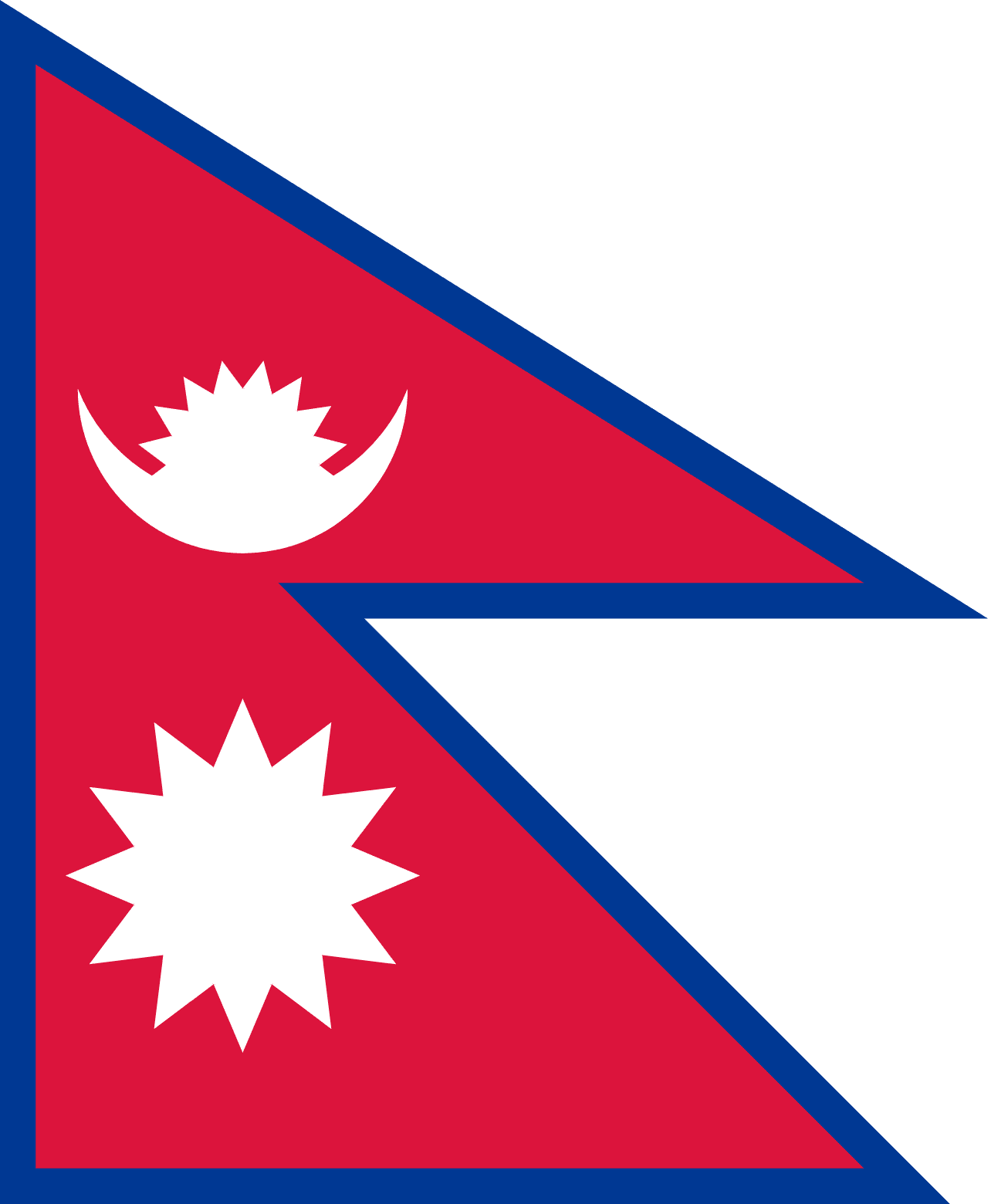
The flag of Nepal is the official national symbol of Federal Democratic Republic of Nepal, whose capital is Kathmandu. On this page you can view and download a high-quality image of the Nepal flag, copy the Nepal flag emoji, and learn key facts about this sovereign country in Asia.
Country information
| Independent | Yes |
|---|---|
| Country codes | NP, NPL (ISO 3166-1) |
| Official name | Federal Democratic Republic of Nepal |
| Capital city | Kathmandu |
| Continent | Asia |
| Member of | United Nations |
| Population | 28,087,871 |
| Total area | 147,181 km² |
| Languages | Nepali |
| Currency | Nepalese rupee (₨, NPR) |
| Calling code | +977 |
| Internet TLD | .np |
About the flag of Nepal
The Nepal flag represents the identity, history and values of its people — the Nepalese people. It is flown on government buildings, at international events and during national celebrations, and it appears at the United Nations, sporting tournaments and diplomatic missions around the world.
Nepal is a landlocked sovereign country located in Southern Asia, covering an area of 147,181 km² with a population of roughly 28,087,871. The main language is Nepali.
Design, meaning and history of the Nepal flag
Design
The flag of Nepal is unique as the only non-rectangular national flag in the world, formed by two stacked pennant shapes. It has a crimson-red field bordered in deep blue, with a stylized white crescent moon emitting eight rays in the upper segment and a white twelve-pointed sun in the lower segment.
Meaning of the colours and symbols
Crimson red is Nepal's national color and represents bravery as well as the rhododendron, the national flower. The blue border symbolizes peace and harmony. The celestial bodies represent longevity, conveying the hope that the nation will endure as long as the sun and the moon.
History
The double-pennant layout evolved from traditional Hindu and South Asian war banners used by rival Himalayan principalities. When King Prithvi Narayan Shah unified Nepal in the late 18th century, the two pennants were combined into a single standard. The modern standardized version was formally adopted on December 16, 1962, when faces previously depicted on the sun and moon were removed.
- Adopted: December 16, 1962
- Proportions: 1:1.219 (approximate)
Interesting facts
- It is the only sovereign national flag that is neither a rectangle nor a square.
- The Constitution of Nepal includes an extraordinarily precise step-by-step geometric recipe for drafting the flag using only a ruler and compass.
- Until 1962, both the sun and the moon emblems featured stylized human facial features.
Map of Nepal
Flags of countries bordering Nepal

More Asian flags


Nepal flag — frequently asked questions
Why is the flag of Nepal not rectangular?
It originates from traditional triangular Hindu battle pennons that were flown in the Himalayas, which were joined together to represent the unified kingdom.
How is the aspect ratio of the Nepalese flag calculated?
The ratio cannot be expressed as a simple fraction because it is defined geometrically in the constitution; its mathematical ratio is approximately 1:1.21901033.
What changes were made to Nepal's flag in 1962?
The 1962 constitution removed the drawn human faces from both the crescent moon and the sun, standardizing them into purely geometric celestial symbols.
What is the capital of Nepal?
The capital city of Nepal is Kathmandu.
What is the Nepal flag emoji?
The Nepal flag emoji is 🇳🇵. Visit the emoji page to copy and paste it.
What are the country codes of Nepal?
The ISO 3166-1 codes for Nepal are NP and NPL.