African flags
Flag of Benin
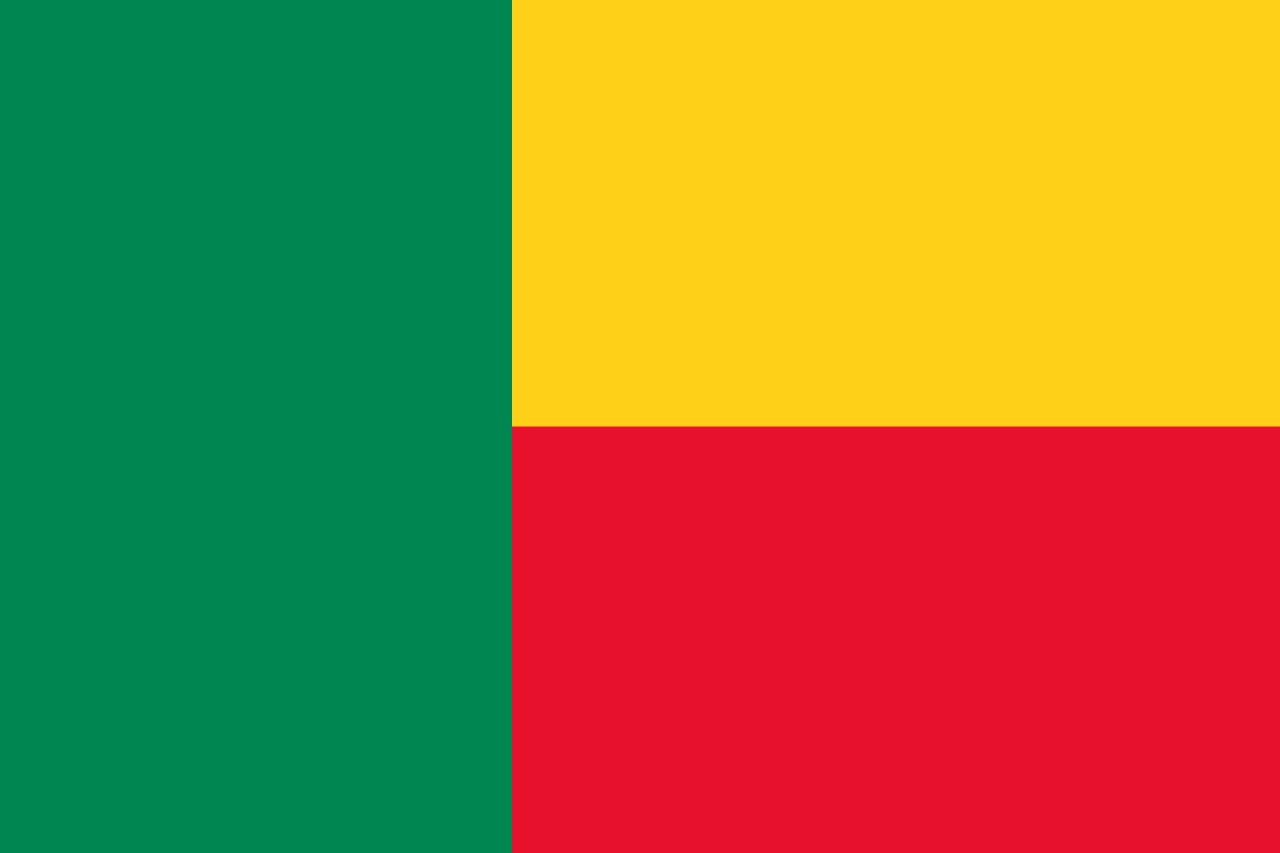
The flag of Benin is the official national symbol of Republic of Benin, whose capital is Porto-Novo. On this page you can view and download a high-quality image of the Benin flag, copy the Benin flag emoji, and learn key facts about this sovereign country in Africa.
Country information
| Independent | Yes |
|---|---|
| Country codes | BJ, BEN (ISO 3166-1) |
| Official name | Republic of Benin |
| Capital city | Porto-Novo |
| Continent | Africa |
| Member of | United Nations, African Union, Organisation internationale de la Francophonie, Organisation of Islamic Cooperation |
| Population | 11,485,048 |
| Total area | 112,622 km² |
| Languages | French |
| Currency | West African CFA franc (Fr, XOF) |
| Calling code | +229 |
| Internet TLD | .bj |
About the flag of Benin
The Benin flag represents the identity, history and values of its people — the Beninese people. It is flown on government buildings, at international events and during national celebrations, and it appears at the United Nations, sporting tournaments and diplomatic missions around the world.
Benin is a sovereign country located in Western Africa, covering an area of 112,622 km² with a population of roughly 11,485,048. The main language is French.
Design, meaning and history of the Benin flag
Design
The flag of Benin features two equal horizontal bands of yellow on top and red on the bottom. Along the hoist is a vertical green stripe that occupies two-fifths of the flag's length.
Meaning of the colours and symbols
The colors are traditional Pan-African hues. Officially, green represents the hope of a new democracy, yellow symbolizes the preservation of the country's wealth, and red honors the courage and sacrifice of the ancestors.
History
The flag was first adopted on November 16, 1959, when the territory was the self-governing Republic of Dahomey, and it was retained upon independence in 1960. Under Mathieu Kérékou's Marxist regime, the flag was replaced on December 1, 1975, with a green field featuring a red five-pointed star in the canton. Following the collapse of the socialist system and the transition to a multi-party republic, the original 1959 flag was reinstated on August 1, 1990.
- Adopted: August 1, 1990
- Proportions: 2:3
Interesting facts
- The vertical green stripe spans two-fifths of the flag's total length rather than the standard one-third.
- The flag was suspended for fifteen years while the country was governed as a Marxist-Leninist state.
- Benin originally flew this flag under its colonial-era and post-independence name, the Republic of Dahomey.
Map of Benin
Flags of countries bordering Benin
More African flags

Benin flag — frequently asked questions
What flag was used in Benin between 1975 and 1990?
During the People's Republic era, Benin flew a plain green flag with a socialist red star placed in the upper hoist corner.
Why are the stripes on the flag of Benin unequally divided?
The vertical green stripe at the hoist is legally specified to take up two-fifths of the length, leaving the remaining three-fifths divided horizontally between yellow and red.
What do the colors of Benin's flag mean?
Officially, green represents hope and agriculture, yellow symbolizes the nation's wealth, and red honors the courage of previous generations.
What is the capital of Benin?
The capital city of Benin is Porto-Novo.
What is the Benin flag emoji?
The Benin flag emoji is 🇧🇯. Visit the emoji page to copy and paste it.
What are the country codes of Benin?
The ISO 3166-1 codes for Benin are BJ and BEN.