African flags
Flag of Burundi
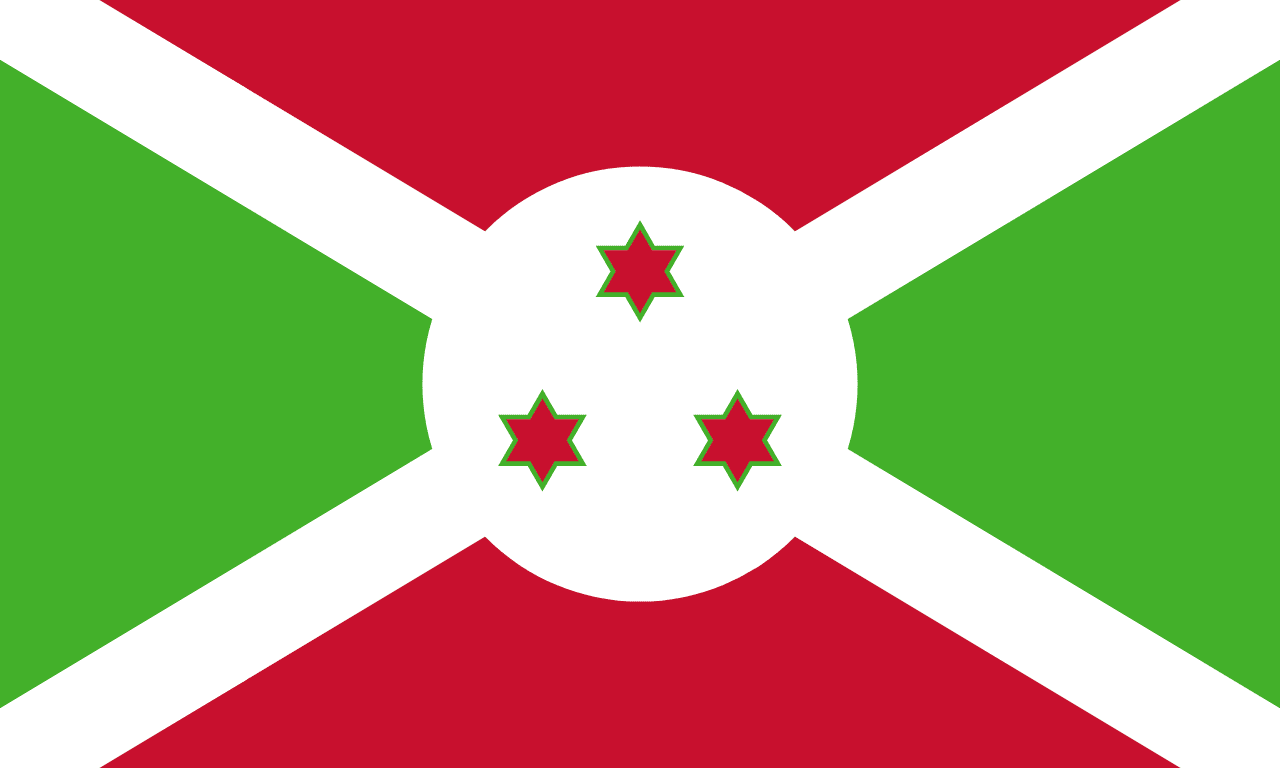
The flag of Burundi is the official national symbol of Republic of Burundi, whose capital is Gitega. On this page you can view and download a high-quality image of the Burundi flag, copy the Burundi flag emoji, and learn key facts about this sovereign country in Africa.
Country information
| Independent | Yes |
|---|---|
| Country codes | BI, BDI (ISO 3166-1) |
| Official name | Republic of Burundi |
| Capital city | Gitega |
| Continent | Africa |
| Member of | United Nations, African Union, Organisation internationale de la Francophonie, East African Community |
| Population | 11,175,378 |
| Total area | 27,834 km² |
| Languages | French, Kirundi |
| Currency | Burundian franc (Fr, BIF) |
| Calling code | +257 |
| Internet TLD | .bi |
About the flag of Burundi
The Burundi flag represents the identity, history and values of its people — the Burundian people. It is flown on government buildings, at international events and during national celebrations, and it appears at the United Nations, sporting tournaments and diplomatic missions around the world.
Burundi is a landlocked sovereign country located in Eastern Africa, covering an area of 27,834 km² with a population of roughly 11,175,378. The main languages are French, Kirundi.
Design, meaning and history of the Burundi flag
Design
The flag of Burundi is divided into four sections by a white saltire (diagonal cross), with the top and bottom triangles colored red and the hoist and fly triangles colored green. In the center, a white circle overlays the saltire and contains three red six-pointed stars outlined in green. The three stars are arranged in a triangular configuration with one above and two below.
Meaning of the colours and symbols
The white color represents peace, green represents hope and agriculture, and red symbolizes the suffering and bloodshed endured in the fight for independence. The three central stars have a dual official meaning: they stand for the three words of the national motto ('Unity, Work, Progress') and commonly represent the country's three major ethnic groups (Hutu, Tutsi, and Twa).
History
When the Kingdom of Burundi became independent on July 1, 1962, the flag featured a traditional 'karyenda' drum and a sorghum plant inside the central disc. Following the abolition of the monarchy in late 1966, the royal drum was removed. The current version containing three stars was officially adopted on March 28, 1967. The flag's ratio was formally updated from 2:3 to 3:5 on September 27, 1982.
- Adopted: March 28, 1967
- Proportions: 3:5
Interesting facts
- The stars on the flag are six-pointed, which is relatively rare on African national flags.
- Before becoming a republic, Burundi's flag featured a karyenda, an ancient sacred drum symbolizing the monarch.
- The white saltire divides the flag's rectangular field into four distinct triangular quadrants.
Map of Burundi
Flags of countries bordering Burundi
More African flags

Burundi flag — frequently asked questions
What do the three stars on the flag of Burundi represent?
They represent the national motto 'Ubumwe, Ibikorwa, Iterambere' (Unity, Work, Progress) as well as the nation's three ethnic groups: the Hutu, Tutsi, and Twa.
What emblem was originally inside the white circle on Burundi's flag?
The flag originally featured a sacred royal drum (karyenda) and a sorghum stalk, which were removed after the monarchy fell in 1966.
What is the official aspect ratio of Burundi's flag?
The official proportions are 3:5, modified from an earlier 2:3 ratio in 1982.
What is the capital of Burundi?
The capital city of Burundi is Gitega.
What is the Burundi flag emoji?
The Burundi flag emoji is 🇧🇮. Visit the emoji page to copy and paste it.
What are the country codes of Burundi?
The ISO 3166-1 codes for Burundi are BI and BDI.