African flags
Flag of Eritrea
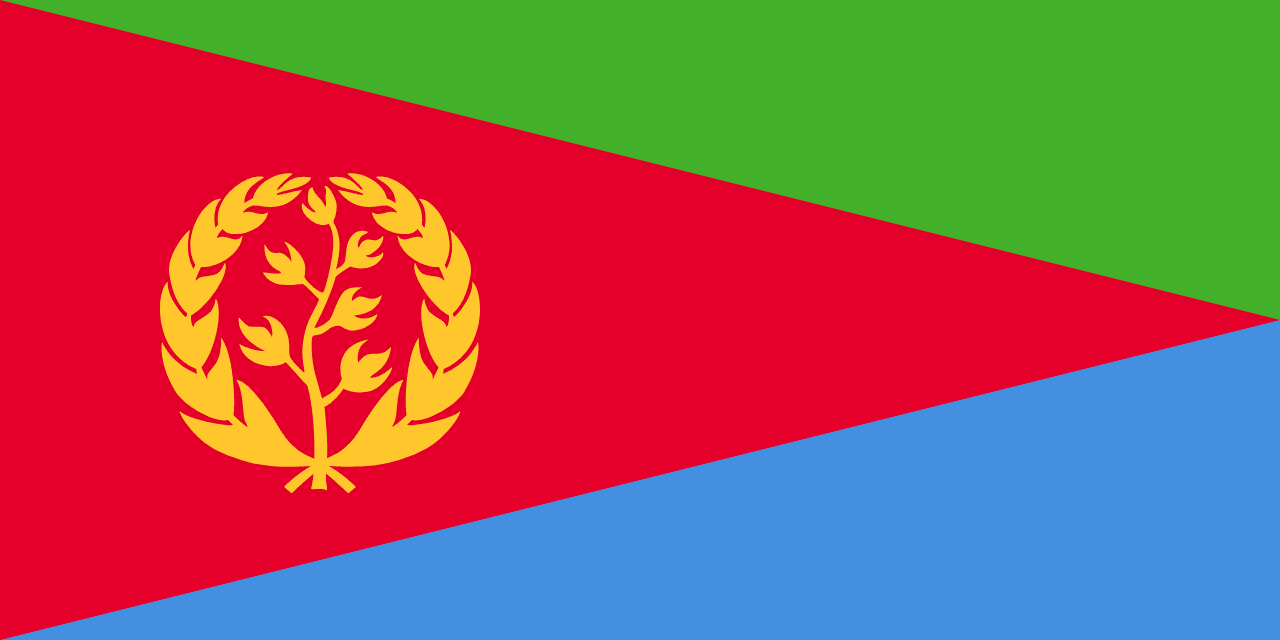
The flag of Eritrea is the official national symbol of State of Eritrea, whose capital is Asmara. On this page you can view and download a high-quality image of the Eritrea flag, copy the Eritrea flag emoji, and learn key facts about this sovereign country in Africa.
Country information
| Independent | Yes |
|---|---|
| Country codes | ER, ERI (ISO 3166-1) |
| Official name | State of Eritrea |
| Capital city | Asmara |
| Continent | Africa |
| Member of | United Nations, African Union |
| Population | 6,213,972 |
| Total area | 117,600 km² |
| Languages | Arabic, English, Tigrinya |
| Currency | Eritrean nakfa (Nfk, ERN) |
| Calling code | +291 |
| Internet TLD | .er |
About the flag of Eritrea
The Eritrea flag represents the identity, history and values of its people — the Eritrean people. It is flown on government buildings, at international events and during national celebrations, and it appears at the United Nations, sporting tournaments and diplomatic missions around the world.
Eritrea is a sovereign country located in Eastern Africa, covering an area of 117,600 km² with a population of roughly 6,213,972. The main languages are Arabic, English, Tigrinya.
Design, meaning and history of the Eritrea flag
Design
The flag of Eritrea is dominated by a red isosceles triangle based along the hoist with its point extending to the middle of the right fly edge. This divides the remaining field into two right-angled triangles: green on top and blue on the bottom. Emblazoned within the red triangle near the hoist is an upright golden olive wreath enclosing an upright olive branch.
Meaning of the colours and symbols
Red symbolizes the blood spilled during the thirty-year war for national liberation. Green represents the agricultural wealth and fertility of the land, while blue signifies the Red Sea and its maritime bounty. The golden olive branch and surrounding wreath symbolize the era of peace won through independence, as well as recalling Eritrea's historic 1952 flag.
History
In 1952, Eritrea adopted a light blue flag bearing a green olive wreath to mark its autonomous federation with Ethiopia. Following annexation by Ethiopia, a protracted armed struggle led by the Eritrean People's Liberation Front (EPLF) ensued, using a flag with red, green, and blue triangles and a yellow star. Upon formal independence, the current national flag was adopted on May 24, 1993, substituting the EPLF's star with the 1952 olive wreath emblem.
- Adopted: May 24, 1993
- Proportions: 1:2
Interesting facts
- The layout is directly adapted from the battle banner of the Eritrean People's Liberation Front (EPLF).
- The golden olive wreath has 30 leaves, commonly interpreted as standing for the thirty years spent fighting for independence.
- The olive wreath motif was originally adopted in 1952 to honour the United Nations' role in establishing Eritrean self-governance.
Map of Eritrea
Flags of countries bordering Eritrea
More African flags

Eritrea flag — frequently asked questions
What is the historical meaning of the olive wreath on Eritrea's flag?
It honors the United Nations, which assisted in granting Eritrea autonomy in 1952, while the surrounding 30 leaves honor the thirty-year liberation struggle.
How does the national flag differ from the EPLF party flag?
The national flag replaced the yellow communist-style star of the EPLF banner with the historic golden olive wreath.
Why is the red triangle shaped that way?
The red triangle narrows toward the fly, symbolizing that the bloodshed of the independence war diminishes as the country moves toward a peaceful future.
What is the capital of Eritrea?
The capital city of Eritrea is Asmara.
What is the Eritrea flag emoji?
The Eritrea flag emoji is 🇪🇷. Visit the emoji page to copy and paste it.
What are the country codes of Eritrea?
The ISO 3166-1 codes for Eritrea are ER and ERI.