African flags
Flag of Namibia
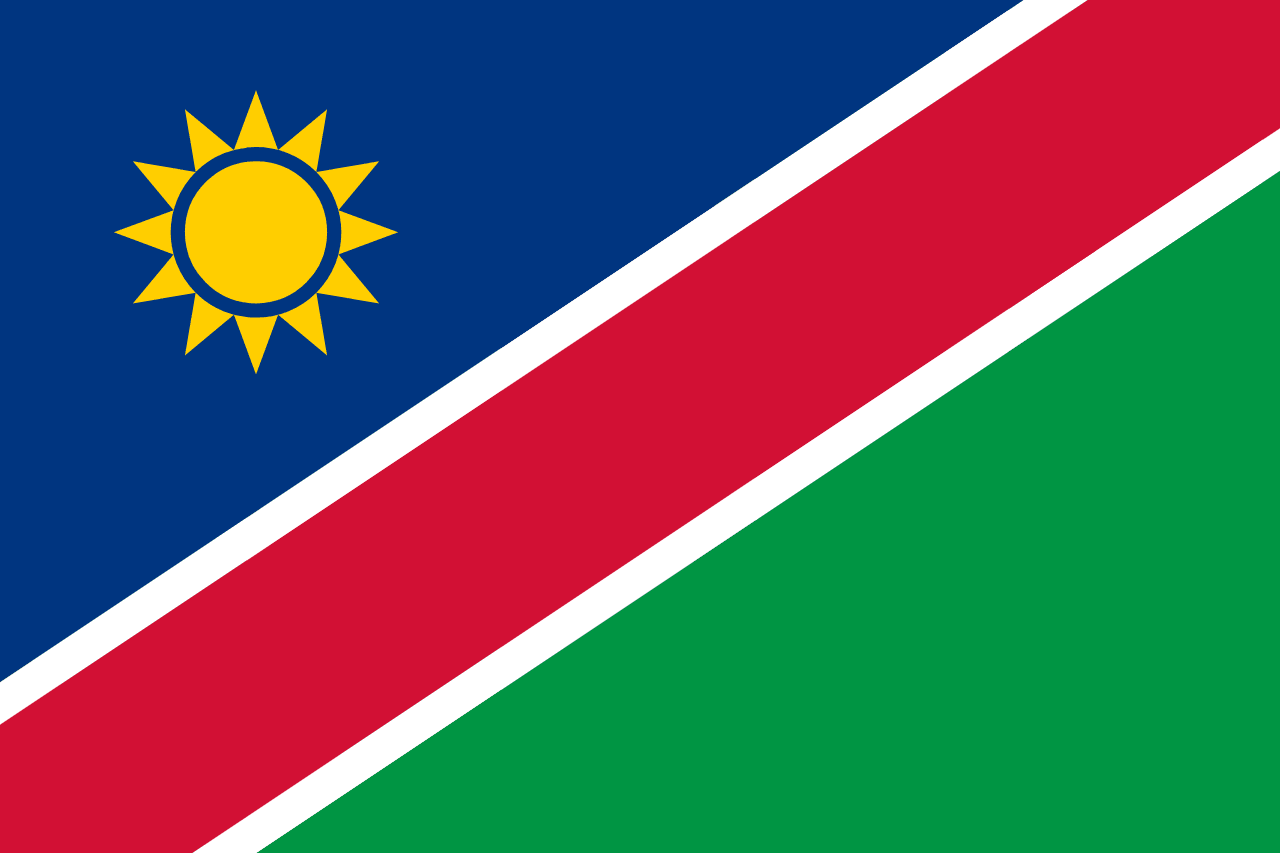
The flag of Namibia is the official national symbol of Republic of Namibia, whose capital is Windhoek. On this page you can view and download a high-quality image of the Namibia flag, copy the Namibia flag emoji, and learn key facts about this sovereign country in Africa.
Country information
| Independent | Yes |
|---|---|
| Country codes | NA, NAM (ISO 3166-1) |
| Official name | Republic of Namibia |
| Capital city | Windhoek |
| Continent | Africa |
| Member of | United Nations, African Union, Commonwealth of Nations, Southern African Development Community |
| Population | 2,448,255 |
| Total area | 825,615 km² |
| Languages | Afrikaans, German, English, Herero, Khoekhoe, Kwangali, Lozi, Ndonga, Tswana |
| Currency | Namibian dollar ($, NAD), South African rand (R, ZAR) |
| Calling code | +264 |
| Internet TLD | .na |
About the flag of Namibia
The Namibia flag represents the identity, history and values of its people — the Namibian people. It is flown on government buildings, at international events and during national celebrations, and it appears at the United Nations, sporting tournaments and diplomatic missions around the world.
Namibia is a sovereign country located in Southern Africa, covering an area of 825,615 km² with a population of roughly 2,448,255. The main languages are Afrikaans, German, English, Herero, Khoekhoe, Kwangali, Lozi, Ndonga, Tswana.
Design, meaning and history of the Namibia flag
Design
The flag of Namibia features a prominent red diagonal stripe edged in white, running from the lower hoist-side corner to the upper fly-side corner. The upper hoist triangle is blue and contains a golden-yellow sun with twelve triangular rays, while the lower fly triangle is green.
Meaning of the colours and symbols
Red symbolizes Namibia's people, their heroism, and determination to build a future of equal opportunity. Blue represents the clear sky and the Atlantic Ocean, gold symbolizes life, energy, and warmth, green stands for vegetation and agricultural resources, and the white fimbriations denote peace and unity.
History
Prior to independence, Namibia was administered by South Africa under a League of Nations mandate and flew the South African flag. Following the United Nations-supervised transition to independence, a national competition was held in 1989 that attracted over 800 submissions. The constituent assembly selected and officially adopted the winning design on March 21, 1990, the day Namibia gained formal independence.
- Adopted: March 21, 1990
- Proportions: 2:3
Interesting facts
- The design was finalized by a subcommittee that synthesized several top entries from a nationwide public competition.
- The twelve rays of the golden sun represent the twelve distinct ethnic groups or communities of Namibia.
- The colors closely align with the traditional palette of the South West Africa People's Organisation (SWAPO), the liberation movement.
Map of Namibia
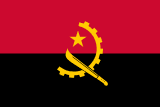
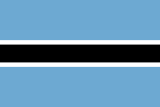
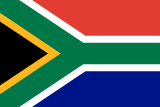
Flags of countries bordering Namibia
More African flags
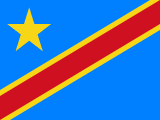

Namibia flag — frequently asked questions
What is the meaning of the 12-pointed sun on Namibia's flag?
The twelve triangular rays of the sun symbolize life and energy, and they also traditionally represent the diverse communities and peoples of Namibia.
Who designed the national flag of Namibia?
The flag's final design was coordinated by the National Symbols Sub-Committee of the Constituent Assembly, which drew primary inspiration from submissions by Roy Allen and Fred Brownell.
Does Namibia use any other official flags?
Namibia has a distinct President's flag, which features the national coat of arms centered on a field divided diagonally into blue and green triangles.
What is the capital of Namibia?
The capital city of Namibia is Windhoek.
What is the Namibia flag emoji?
The Namibia flag emoji is 🇳🇦. Visit the emoji page to copy and paste it.
What are the country codes of Namibia?
The ISO 3166-1 codes for Namibia are NA and NAM.