African flags
Flag of Gambia
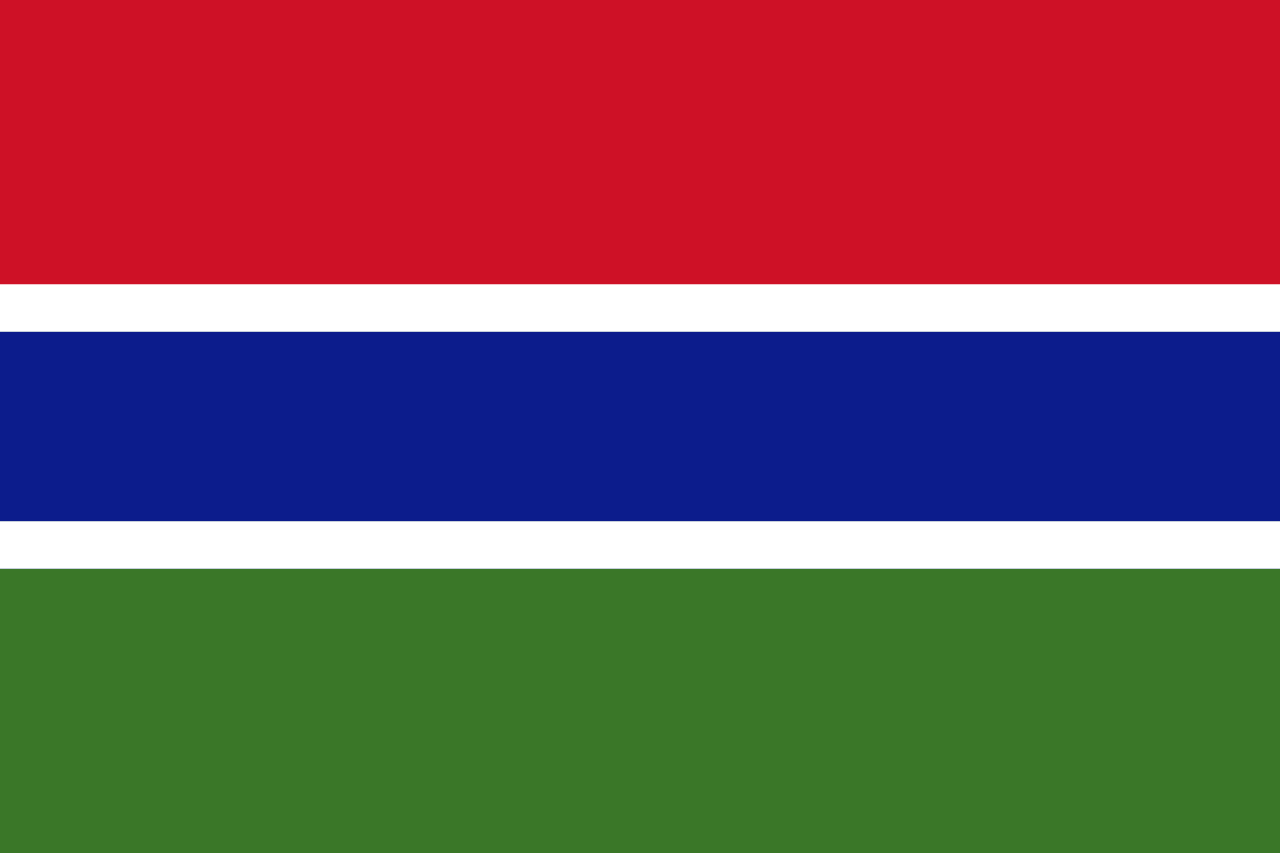
The flag of Gambia is the official national symbol of Republic of the Gambia, whose capital is Banjul. On this page you can view and download a high-quality image of the Gambia flag, copy the Gambia flag emoji, and learn key facts about this sovereign country in Africa.
Country information
| Independent | Yes |
|---|---|
| Country codes | GM, GMB (ISO 3166-1) |
| Official name | Republic of the Gambia |
| Capital city | Banjul |
| Continent | Africa |
| Member of | United Nations, African Union, Commonwealth of Nations, Organisation of Islamic Cooperation |
| Population | 2,280,102 |
| Total area | 10,689 km² |
| Languages | English |
| Currency | dalasi (D, GMD) |
| Calling code | +220 |
| Internet TLD | .gm |
About the flag of Gambia
The Gambia flag represents the identity, history and values of its people — the Gambian people. It is flown on government buildings, at international events and during national celebrations, and it appears at the United Nations, sporting tournaments and diplomatic missions around the world.
Gambia is a sovereign country located in Western Africa, covering an area of 10,689 km² with a population of roughly 2,280,102. The main language is English.
Design, meaning and history of the Gambia flag
Design
The flag of The Gambia consists of three horizontal bands of red, blue, and green, separated by two thin white fimbriations. The central blue stripe is narrower than the red and green stripes, while the white borders are narrower still. The overall proportion of the stripes is 6:1:4:1:6.
Meaning of the colours and symbols
Red symbolizes the sun and the savannas of the interior. Blue represents the Gambia River, the central geographical feature that runs through the heart of the country. Green stands for the land, agriculture, and forests, while the thin white stripes represent peace and unity.
History
Prior to independence, the British colony and protectorate used a British Blue Ensign defaced with an elephant and palm tree badge. In anticipation of self-rule, accountant Pa Louis Thomasi designed the current national flag. It was officially adopted on February 18, 1965, the day The Gambia achieved independence from the United Kingdom.
- Adopted: February 18, 1965
- Proportions: 2:3
Interesting facts
- The flag was designed by a Gambian accountant named Pa Louis Thomasi rather than a government committee.
- The blue stripe explicitly depicts the Gambia River, which divides the country lengthwise.
- The flag remained unchanged throughout the Senegambia Confederation between 1982 and 1989.
Map of Gambia
Flags of countries bordering Gambia
More African flags

Gambia flag — frequently asked questions
Who designed the national flag of The Gambia?
The flag was created by Pa Louis Thomasi, an accountant from Banjul, who submitted the winning design prior to independence.
What do the thin white lines in the Gambian flag signify?
The white stripes separate the colored fields and symbolize peace, unity, and purity.
What does the blue stripe in the center represent?
The blue stripe represents the Gambia River, the defining geographical axis around which the entire country is formed.
What is the capital of Gambia?
The capital city of Gambia is Banjul.
What is the Gambia flag emoji?
The Gambia flag emoji is 🇬🇲. Visit the emoji page to copy and paste it.
What are the country codes of Gambia?
The ISO 3166-1 codes for Gambia are GM and GMB.