African flags
Flag of Mali
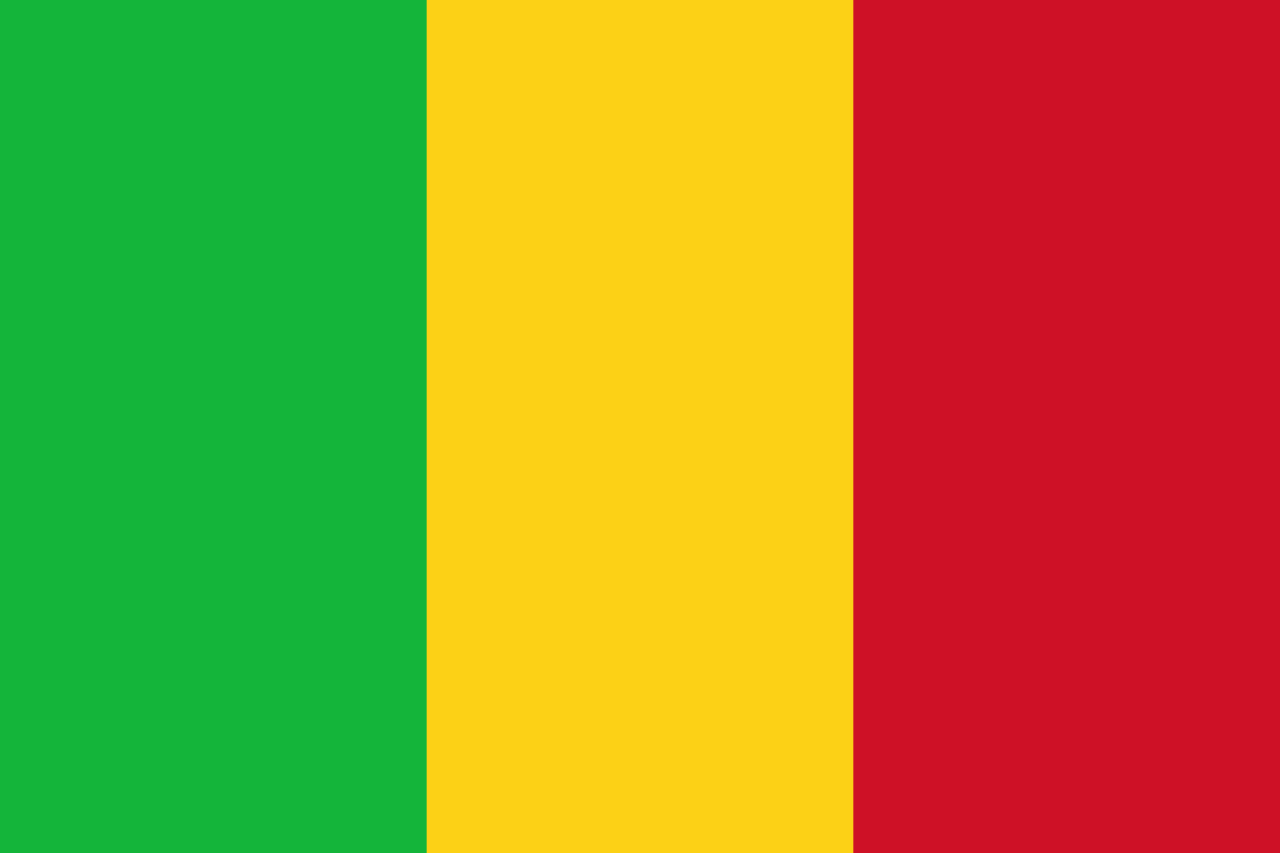
The flag of Mali is the official national symbol of Republic of Mali, whose capital is Bamako. On this page you can view and download a high-quality image of the Mali flag, copy the Mali flag emoji, and learn key facts about this sovereign country in Africa.
Country information
| Independent | Yes |
|---|---|
| Country codes | ML, MLI (ISO 3166-1) |
| Official name | Republic of Mali |
| Capital city | Bamako |
| Continent | Africa |
| Member of | United Nations, African Union, Organisation internationale de la Francophonie, Organisation of Islamic Cooperation |
| Population | 19,077,690 |
| Total area | 1,240,192 km² |
| Languages | French |
| Currency | West African CFA franc (Fr, XOF) |
| Calling code | +223 |
| Internet TLD | .ml |
About the flag of Mali
The Mali flag represents the identity, history and values of its people — the Malian people. It is flown on government buildings, at international events and during national celebrations, and it appears at the United Nations, sporting tournaments and diplomatic missions around the world.
Mali is a landlocked sovereign country located in Western Africa, covering an area of 1,240,192 km² with a population of roughly 19,077,690. The main language is French.
Design, meaning and history of the Mali flag
Design
The national flag of Mali is a vertical tricolor consisting of three equal bands of green, gold (yellow), and red. It is a straightforward design without emblems or charges, adhering to standard Pan-African colors. The proportion of the flag is 2:3.
Meaning of the colours and symbols
Green symbolizes the fertility of the land, agriculture, and the natural resources of the southern regions. Gold represents mineral wealth, particularly gold, along with purity and the sunshine that covers the nation. Red evokes the sacrifice and blood shed by Malians to defend their freedom and independence against foreign domination.
History
In 1959, the Mali Federation (uniting French Sudan and Senegal) adopted a green-yellow-red vertical tricolor featuring a black stick-figure emblem known as a 'kanaga' centered in the yellow stripe. After Senegal withdrew and the federation dissolved in 1960, the Sudanese Republic became the independent Republic of Mali. Due to religious objections from conservative Muslims against depicting human figures, the kanaga was removed by law on March 1, 1961, creating the modern plain tricolor.
- Adopted: March 1, 1961
- Proportions: 2:3
Interesting facts
- The flag originally featured a black human stick figure called a 'kanaga' in the middle of the yellow stripe.
- The kanaga was an artistic representation of a Dogon masked dancer, linking the emblem to local indigenous heritage.
- Mali's colors are the classic Pan-African colors, reflecting the country's historic commitment to African unity.
Map of Mali
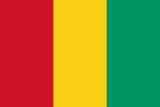
Flags of countries bordering Mali
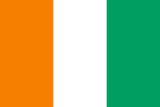
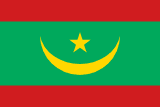
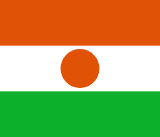
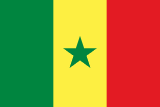
More African flags

Mali flag — frequently asked questions
What was the 'kanaga' on Mali's former flag?
The kanaga was a stylized black stick figure representing a masked dancer from Dogon cosmology, featured on the flag of the Mali Federation and early independent Mali.
Why was the kanaga emblem removed in 1961?
It was removed following pressure from the nation's Muslim majority, who objected to the depiction of human figures on the national emblem.
How does Mali's flag differ from the flag of Guinea?
Mali's flag has its stripes arranged green-yellow-red from hoist to fly, while Guinea's flag displays the reverse order: red-yellow-green.
What is the capital of Mali?
The capital city of Mali is Bamako.
What is the Mali flag emoji?
The Mali flag emoji is 🇲🇱. Visit the emoji page to copy and paste it.
What are the country codes of Mali?
The ISO 3166-1 codes for Mali are ML and MLI.