African flags
Flag of Uganda
The flag of Uganda is the official national symbol of Republic of Uganda, whose capital is Kampala. On this page you can view and download a high-quality image of the Uganda flag, copy the Uganda flag emoji, and learn key facts about this sovereign country in Africa.

Country information
| Independent | Yes |
|---|---|
| Country codes | UG, UGA (ISO 3166-1) |
| Official name | Republic of Uganda |
| Capital city | Kampala |
| Continent | Africa |
| Member of | United Nations, African Union, Commonwealth of Nations, Organisation of Islamic Cooperation, East African Community |
| Population | 42,723,139 |
| Total area | 241,550 km² |
| Languages | English, Swahili |
| Currency | Ugandan shilling (Sh, UGX) |
| Calling code | +256 |
| Internet TLD | .ug |
About the flag of Uganda
The Uganda flag represents the identity, history and values of its people — the Ugandan people. It is flown on government buildings, at international events and during national celebrations, and it appears at the United Nations, sporting tournaments and diplomatic missions around the world.
Uganda is a landlocked sovereign country located in Eastern Africa, covering an area of 241,550 km² with a population of roughly 42,723,139. The main languages are English, Swahili.
Design, meaning and history of the Uganda flag
Design
The flag consists of six equal horizontal stripes arranged in the repeating sequence of black, yellow, red, black, yellow, and red. A white disc is centered over the stripes and contains an East African grey crowned crane facing toward the hoist. The crane is depicted with one raised leg against the white background.
Meaning of the colours and symbols
Black represents the indigenous peoples of the African continent, while yellow symbolizes the abundant tropical sunshine across Uganda. Red represents universal African brotherhood and the blood that unites all people. The grey crowned crane was chosen for its gentle and proud nature, and its raised leg symbolizes the nation's forward progress.
History
During the British colonial era, Uganda used a British Blue Ensign defaced with the crested crane in a circular disc. Prior to full independence, an interim green, blue, and yellow design proposed by the Democratic Party was briefly used in 1962. After the Uganda People's Congress won elections later that year, Minister of Justice Grace Ibingira designed the current six-striped flag, which was officially adopted on independence day, October 9, 1962.
- Adopted: October 9, 1962
- Proportions: 2:3
Interesting facts
- The grey crowned crane has served as the national bird of Uganda since British colonial authorities first adopted it as a military badge.
- The three colors were inspired by the party colors of the ruling Uganda People's Congress.
- The crane always faces the hoist side, which represents looking forward toward the future.
Map of Uganda
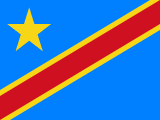
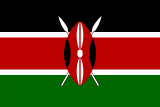
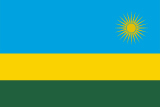
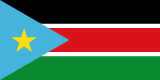
Flags of countries bordering Uganda
More African flags

Uganda flag — frequently asked questions
What bird is depicted on the flag of Uganda?
The bird is the grey crowned crane (Balearica regulorum gibbericeps), which is native to eastern and southern Africa and serves as Uganda's national symbol.
Who designed Uganda's national flag?
The flag was designed by Grace Ibingira, who was serving as Uganda's Minister of Justice ahead of independence in 1962.
Why are the stripes repeated twice?
The six-stripe arrangement repeats the three national colors symmetrically, providing a balanced backdrop that frames the central white disc.
What is the capital of Uganda?
The capital city of Uganda is Kampala.
What is the Uganda flag emoji?
The Uganda flag emoji is 🇺🇬. Visit the emoji page to copy and paste it.
What are the country codes of Uganda?
The ISO 3166-1 codes for Uganda are UG and UGA.